Physical Address
304 North Cardinal St.
Dorchester Center, MA 02124
Physical Address
304 North Cardinal St.
Dorchester Center, MA 02124


In eastern Oregon’s high desert, a small conservation effort at the Rees Training Center has grown into one of the nation’s most successful burrowing owl colonies.
In the wide, dry expanse of eastern Oregon, one of the nation’s most thriving burrowing owl colonies has taken root in the middle of a military training ground.
At the Oregon Military Department’s Rees Training Center, a small conservation project that began with just a handful of nesting pairs nearly two decades ago has evolved into a thriving population of more than 100 burrowing owls.
What started as an experiment in 2008 is now considered one of the most successful burrowing owl colonies in the United States.
“This has become one of the most successful colonies in the country,” said Janet Johnson, the Natural Resources Program Manager for the Oregon Military Department, in a news release. “Last year was exceptional — the forage was abundant, and the owl population doubled between 2023 and 2024.”
Burrowing owls are small, long-legged raptors known for living underground rather than in trees.
They spend much of their time hunting insects and small prey near their burrows. Though capable of flight, they rely heavily on open landscapes to survive.
In Oregon, the species is listed as “a species of concern” and protected under the federal Migratory Bird Treaty Act.
The Rees Training Center’s conservation story began with a creative partnership and a few recycled barrels.
In 2008, the Oregon Military Department joined forces with the Confederated Tribes of the Umatilla Indian Reservation and the Global Owl Project to rebuild disappearing owl habitat.
Natural badger burrows, once common on the land, had declined as military operations expanded. To replace them, researchers built artificial burrows using old apple juice barrels from a local processing plant. Each setup included two underground chambers — one for nesting, one for food storage — connected by irrigation tubing that mimicked a natural tunnel.
The system proved durable, lasting up to 15 years and easily moved when training areas shifted.
Nearly 20 years later, the Rees owl colony has become a model for wildlife conservation within active military zones.
Every owl hatched or living at the site, adults and chicks, has been banded and tracked.
“We’ve documented six generations,” said Johnson. “We know every parent, every chick, and where they came from.”
The long-term data collected from the site has fueled new scientific understanding of owl behavior, from migration routes to vocal communication.
According to the Oregon Military Department, the research has led to nine separate scientific breakthroughs in burrowing owl biology.
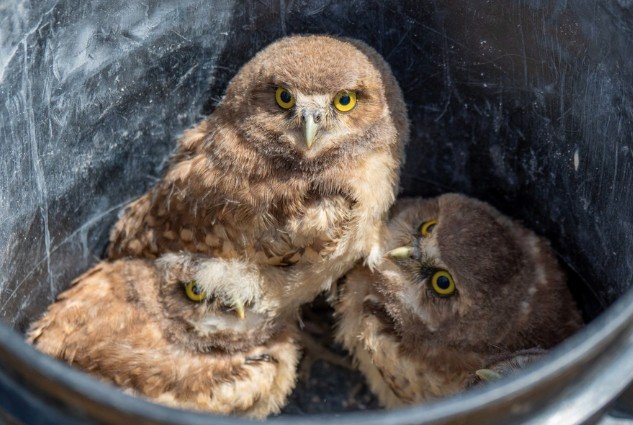
About two-thirds of the owl population now extends onto neighboring tribal lands, where the Confederated Tribes of the Umatilla Indian Reservation oversee an ongoing conservation effort.
“The military biologists and the tribal team work together as one,” Johnson said. “The tribe has invested heavily in this project, and that collaboration is what keeps the colony thriving.”
Wildlife Habitat Ecologist Lindsay Chiono helps coordinate management between tribal lands and the training center.
The success at Rees Training Center stands as an example of how military readiness and environmental stewardship can coexist.
What began as an effort to protect an at-risk species has become a blueprint for conservation partnerships nationwide, and a reminder that even in the most unexpected places, wildlife can flourish when given the chance.